
July 2026
 What is your definition of quality? Ask this of different people and you will get different answers. For some, it is simple – I know it when I see it. For others, it is meeting customer requirements. Surely the quality gurus of the 20th century agreed on a definition of quality. No, not even close. But, as we will see, the disagreement is due that quality can be viewed from different angles. The lens the gurus looked through were different. These different lenses provide a number of different ways of answering the question:
What is quality?
This publication walks through the major definitions of quality and ends with the statistical foundation behind Dr. Taguchi’s contribution – the one most directly connected to the control charts.
In this issue:
- Why Isn’t There One Single Definition
- Walter Shewhart
- W. Edwards Deming
- Joseph Juran
- Philip Crosby
- Armand Feigenbaum
- Kaoru Ishikawa
- Genichi Taguchi
- SPC and On Target with Minimum Variance
- Summary
- References
- Quick Links
Please feel free to leave a comment at the end of this publication. You can download a pdf copy of this publication at this link.
Why Isn’t There One Single Definition
The quality gurus of the 20th century each had a different focus for quality improvement. David Garvin (What Does ‘Product Quality’ Really Mean?” Sloan Management Review, Fall 1984) analyzed these approaches and identified five general ones. As you read the publication, you will see that each guru focused on a different approach, leading to differences in a definition of quality. The approaches identified by Garvin are shown in Table 1.
Table 1: Garvin’s Five Approaches to Quality
| Approach | Core Idea |
| Transcendent | Quality is excellence – you recognize it, even if you cannot define it precisely |
| Product-based | Quality is a function of measurable product attributes |
| User-based | Quality is fitness for the user’s intended purpose |
| Manufacturing-based | Quality is conformance to specifications and requirements |
| Value-based | Quality is the right combination of performance and price |
We will now present an overview of each quality guru from the 20th century. You may believe that this list is not complete and that I left someone off. These are the ones that I studied about once I became involved in quality back in the early 1980s. They are the gurus who helped define quality in the mid-20th century. Please leave a comment if you think I left someone off the list!
Walter Shewhart
Our regular readers know that our SPC Knowledge Base articles mainly focus on variation and control charts. So, we really need to start with Walter Shewhart, the father of SPC. He developed the control chart while working at Bell Labs in the 1920s. His book, Economic Control of Quality of Manufactured Product, introduced how to use control charts in manufacturing.
Dr. Shewhart was born on 3/18/1891 in New Canton, IL. He earned a bachelor’s degree and a master’s degree from University of Illinois Urbana- Champaign. He received a Ph.D. in physics from the University of California, Berkeley. He passed away on 3/11/1967 in Troy Hills, New Jersey.
Dr. Shewhart split quality into two parts:
- Objective Quality: this refers to the measurable characteristics of a product that conform or does not conform to specifications, e.g., dimensions of a part.
- Subjective Quality: this refers to how customer’s feel about the product; e.g., appearance, reliability, etc.
Most of us have focused on the control chart aspect of Dr. Shewhart’s work. Key points about his approach include:
- Using control charts to maintain predictable performance by keeping the process in statistical control by finding and removing special causes of variation
- Reducing variation to improve consistency
- Focusing on prevention, not just inspection
- Using the plan, do, check, act (PDCA) cycle for continuous improvement
W. Edwards Deming
Dr. Deming was born on 10/14/1900 in Sioux City, Iowa. He earned a bachelor’s degree in engineering from the University of Wyoming, a master’s degree in mathematics and physics from the University of Colorado Boulder, and a Ph.D. in mathematical physics from Yale University. He became known internationally for promoting SPC, systems thinking, and continuous improvement, He is credited with helping Japan rebuild after World War II. He passed away 12/20/1993.
Dr. Shewhart was a mentor to Dr. Deming. They worked together at Bell Labs. Dr. Deming strongly embraced Dr. Shewhart’s approach to managing process variation. Dr. Deming took that approach and built it into a comprehensive management philosophy based on continual improvement, systems thinking, and leadership. He wrote this about quality:
“The basic problem anywhere is quality. What is quality? A product or a service possesses quality if it helps somebody and enjoys a good and sustainable market.”
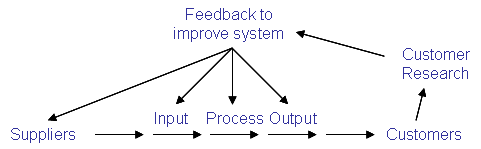
In his book, Out of the Crisis (1982), Dr. Deming says that quality should be aimed at customer needs – present and future. He looked at quality as an ongoing cycle of improvement involving suppliers, the process, the customers, customer research and feedback to continually improve the system. This is shown in the figure below.
Quality and statistical control were inseparable to Dr. Deming. If your process is not predictable, you can’t produce reliable product. This makes control charts central to quality – they are the technique that tells you whether a process is stable enough (in statistical control) to be able to create quality products in the first place.
Dr. Deming went far beyond a definition of “quality.” He created a management system based on his 14 points and his four bodies of profound knowledge. These four bodies are:
- Appreciation for a system
- Knowledge of variation
- Theory of knowledge
- Knowledge of psychology
To learn more about Dr. Deming please see our five publications about Dr. Deming on our SPC Knowledge Base.
Joseph Juran
Juran was born 12/24/1904 in Romania. He emigrated to the USA in 1912. He received a BS in electrical engineering from the University of Minnesota. He also received a Bachelor of Laws from Loyola University Chicago. He worked at Western Electric’s Hawthorne Works. He was on the world’s leading quality consultants. He passed away 2/28/2008.
Juran’s definition of quality is short and to the point:
Quality is fitness for use.
He felt that quality should meet the needs and expectations of the customer. His approach highlighted that it was management’s responsibility to achieve quality through effective planning and control
Juran divided quality into two dimensions:
- Features: the product or service characteristics that meet customer needs and thus impacts income.
- Freedom from deficiencies: absence of failures and defects that impact cost
So, features help growth, while reducing deficiencies reduces cost. These two dimensions led to Juran’s Quality Trilogy – quality planning, quality control and quality improvement.
Philip Crosby
Crosby was born 6/18/1926 in Wheeling, West Virigina. He was in the navy during World War II. He did not complete a college degree. His experience in quality management came from working with companies like Martin Marietta and International Telephone and Telegraph. He founded his own consulting firm. He passed away on 8/18/2001.
Crosby’s definition of quality was very rigid:
Quality is conformance to requirements.
Quality was conformance to specifications set by management and based on customer needs. A product either meets the specifications, or it does not.
Tied to his definition of quality were two other ideas:
- Zero defects is the performance standard.
- Quality is free – the cost of defects, scrap, etc. exceeds the cost of preventing defects in the first place.
Crosby held a binary view of quality – it met specifications or did not. Dr. Taguchi directly targets this as you will see below.
Armand Feigenbaum
Dr. Feigenbaum was born on 4/6/1922 in New York City. He received his bachelor’s degree, master’s degree and Ph.D. in economics from Massachusetts Institute of Technology. He passed away 11/13/2014.
He worked for General Electric, where he developed the concept of Total Quality Control. This approach emphasized that quality is the responsibility of every department, not just inspection. So, his impact was on the organization, not statistical. He defined quality as the following:
Quality is the total composite of product and service characteristics – spanning marketing, engineering, manufacturing, and maintenance – through which the product in use will meet customer expectations.
This idea became a foundation of the later Total Quality Management movement.
He also introduced the hidden plant concept. A certain amount of a plant’s capability is wasted. Dr. Feigenbaum estimated up to 40% of a plant’s capacity is wasted.
Kaoru Ishikawa
Dr. Ishikawa was born on 7/13/1915 in Tokyo, Japan. He received a degree in applied chemistry and later a doctorate in engineering from the University of Tokyo. He passed away 4/16/1989.
He developed company-wide quality control in Japan and introduced quality circles, involving all employees in quality improvement. He created the fishbone diagram (also called cause and effect, and Ishikawa diagram) as one of his “seven basic quality tools.” For more information on these seven tools, please see our SPC Knowledge Base publication, Dr. Ishikawa’s Seven Quality Tools.
For Dr. Ishikawa, quality means the quality of everything: after sales service, management, employees, etc. Quality had to be company wide and involve every person from the top management to the production floor.
Genichi Taguchi
Dr. Taguchi was born 1/1/1924 in Tokamachi, Niigata Prefecture, Japan. He earned a doctorate in science. He worked for Japan’s Ministry of Public Health and Welfare before moving to Nippon Telegraph and Telephone. He passed away on 6/2/2012.
He defined quality as the following:
Quality is the minimum loss imparted to society from the time a product is shipped.
How do you accomplish this?
- A product should hit its target value, not merely stay within specification limits.
- Variation around the target should be minimized.
- Any deviation from the target causes a loss to society, even if the product remains within specifications.
Dr. Taguchi’s definition is very relevant to SPC, because it directly challenges the binary view behind traditional specification limits. Over time, his definition has become:
Quality is on target with minimum variance.
The traditional view of variation had been that if the result is within specifications, all is good. If a result is out of specifications, all is bad. There is no difference between a point that is right on target and one almost out of specification.
Dr. Taguchi said this was wrong. In his view, any deviation from the target – even one still inside the spec limits – creates a loss to the customer, the company, and society, and that loss grows the further you move away from target.
This specification approach and Taguchi’s approach are both shown in the figure below. The red, dotted lines represent the traditional view. As long as a result is within specifications, there is no loss. If it is outside the specifications, there is a loss.
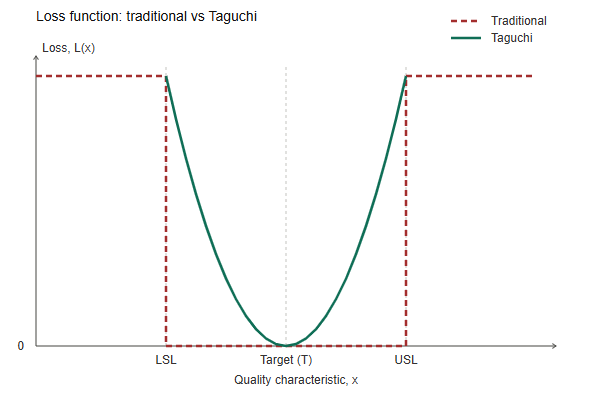
The solid green line is Taguchi’s quadrative loss function. It is given by:
L(x) = k(x − T)²
where L(x) is the loss (usually in dollars) associated with a given value of the quality characteristic, x is the actual measured value, T is the target value, and k is a constant determined by the cost at the specification limit. This equation says that if you are on target, there is no loss. However, if you are not on target, there is a loss. Large deviations from target generate more loss than small deviations from target because of the squared term in the equation.
Extending this across an entire process with mean μ and variance σ², the expected loss per unit works out to be:
E[L] = k[(μ – T)² + σ²]
This shows that the expected loss comes from two sources: how far the average is from the target and how much variation there is about that average.
The phrase “On Target with Minimum Variance” was used by Dr. Donald Wheeler and David Chambers’ in their book Understanding Statistical Process Control. They wrote that Taguchi’s loss function “leads unavoidably to a new definition of world-class quality – ‘On Target with Minimum Variance.’
SPC and On Target with Minimum Variance
So, world class quality is now defined as on target with minimum variance. How do you track this? Control charts. A control chart will tell you how far off target your process average is (e.g., and X charts) and how much variation there is in your process (R and mR charts). The goal is to maintain the process at target and to continually reduce variation.
Summary
This publication covered the definitions of quality created by the 20th century gurus. The definitions differ because they tend to look at quality through different lenses. The most quoted definition of quality is now on target with minimum variation from Dr. Taguchi. And this definition fits perfectly with using control charts.
References
Below are references you can access if you want to learn more about these quality gurus.
- Garvin, David A. “What Does ‘Product Quality’ Really Mean?” Sloan Management Review, Fall 1984.
- Shewhart, Walter A. Economic Control of Quality of Manufactured Product. Van Nostrand Company, 1931.
- Deming, W. Edwards. Out of the Crisis. MIT Center for Advanced Engineering Study, 1982.
- Juran, Joseph M. Quality Control Handbook. McGraw-Hill, 1951 (3rd ed., 1979).
- Crosby, Philip B. Quality Is Free: The Art of Making Quality Certain. McGraw-Hill, 1979.
- Feigenbaum, Armand V. Total Quality Control. McGraw-Hill, 1951 (3rd ed., 1983).
- Ishikawa, Kaoru. What Is Total Quality Control? The Japanese Way. Prentice Hall, 1985.
- Wheeler, Donald J., and David S. Chambers. Understanding Statistical Process Control, 2nd ed. SPC Press, 1992


 wpDiscuz